Please join us on February 11th at 7:30pm ET - 4:30pm PT
This month we will talk about how children actually learn and grow. Our primary reading to support this discussion is Alison Gopnick’s book, The Gardener and the Carpenter - Macmillan Publishers
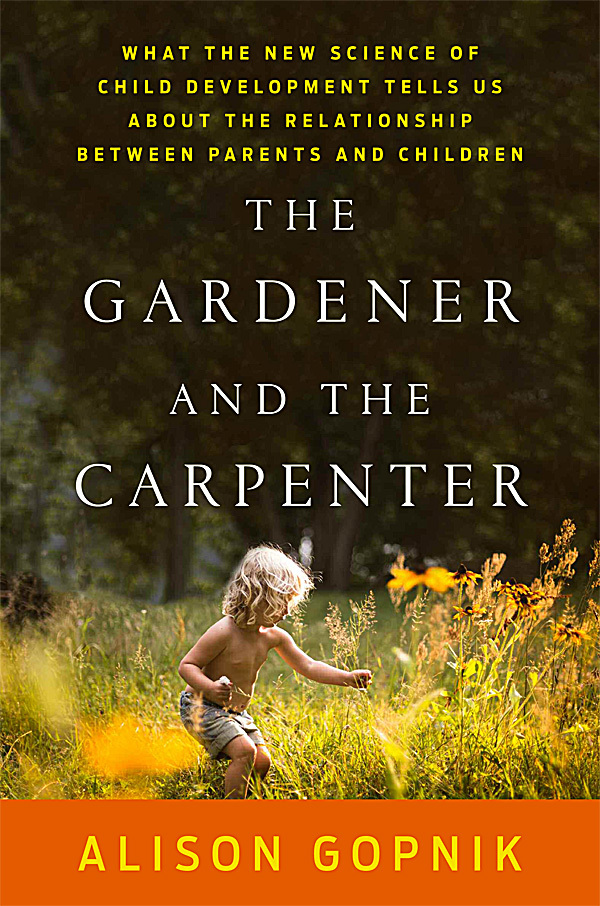
Caring deeply about our children is part of what makes us human. Yet the thing we call "parenting" is a surprisingly new invention. In the past thirty years, the concept of parenting and the multibillion-dollar industry surrounding it have transformed child care into obsessive, controlling, goal-oriented labor intended to create a particular kind of child and thereby a particular kind of adult. In The Gardener and the Carpenter, the pioneering developmental psychologist and philosopher Alison Gopnik argues that the familiar twenty-first-century picture of parents and children is profoundly wrong - it's not just based on bad science, it's also bad for kids and parents.
Drawing on the study of human evolution and on her own cutting-edge scientific research into how children learn, Gopnik shows that although caring for children is immensely important, the goal shouldn't be to shape them so they turn out a certain way. Children are designed to be messy and unpredictable, playful and imaginative, and very different both from their parents and from one another. The variability and flexibility of childhood allow them to innovate, create, and survive in an unpredictable world. "Parenting" won't make children learn - rather, caring parents let children learn by creating a secure, loving environment.
How can we apply the lessons of The Carpenter and the Gardener in our schools and centers?
Join us for stories, strategies, and conversation.
No time to read the book? Here are some suggested short cuts.
Podcasts:
- Hidden Brain: The Carpenter Vs. The Gardener: Two Models Of Modern Parenting https://www.npr.org/2017/12/11/569907638/the-carpenter-vs-the-gardener-two-models-of-modern-parenting
Articles:
- The carpenter vs. the gardener: Two models of modern parenting. NPR. https://www.npr.org/2017/12/11/569907638/the-carpenter-vs-the-gardener-two-models-of-modern-parenting
Videos:
- The Talks at Google: The Gardener and The Carpenter https://www.youtube.com/watch?v=xURCmzmQG8s
Ready for a deep dive? Here are some options for going deeper in Fun and Play.
- Gopnik, A., Griffiths, T. L., & Lucas, C. G. (2015). When younger learners can be better (or at least more open-minded) than older ones. Current Directions in Psychological Science, 24(2), 87–92. https://doi.org/10.1177/0963721414556653
- Gopnik, A. (2020). Childhood as a solution to explore–exploit tensions. Philosophical Transactions of the Royal Society B: Biological Sciences, 375(1803), 20190502. https://doi.org/10.1098/rstb.2019.0502
- Hawkes, K. (2003). Grandmothers and the evolution of human longevity. American Journal of Human Biology, 15(3), 380–400. https://doi.org/10.1002/ajhb.10156
- McCrew, W. (2009) With a little help from my friends. American Scientist, 98(2), 164. https://www.americanscientist.org/article/with-a-little-help-from-my-friends
Join the Mailing List
Sign Up to receive announcements of future Sudbury Community Book Club events and an invitation to our virtual book club community for ongoing conversations.